The Machine That Kills Bad People 1952 ITA SUB ENG 1080p BluRay x...
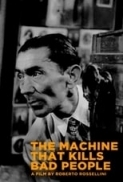
The Machine That Kills Bad People
ComedyFantasy
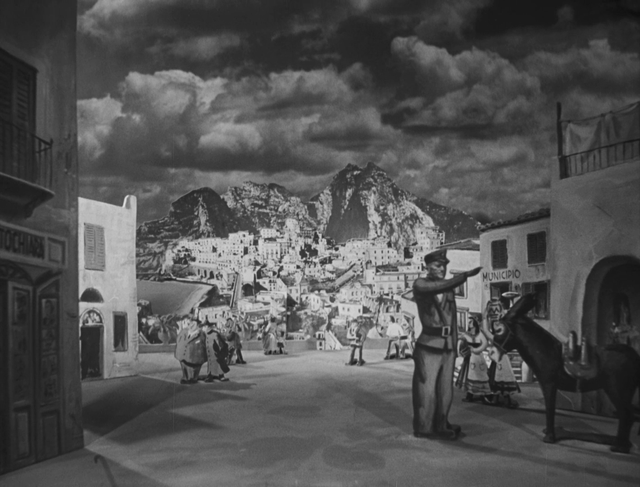
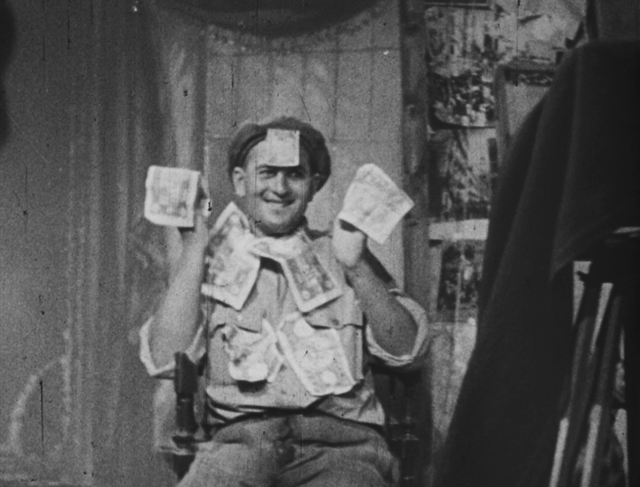
In Amalfi, a village on the Italian coast, an old man who seems to have strange powers gives Celestino Esposito, the local photographer, a dangerous ability.
About The Machine That Kills Bad People
Overview
In Amalfi, a village on the Italian coast, an old man who seems to have strange powers gives Celestino Esposito, the local photographer, a dangerous ability.
Genre
ComedyFantasy
Release Year
1952
Cast
Gennaro Pisano, Marilyn Buferd, William Tubbs, Helen Tubbs IMDB: Link Language : Italian Subtitles : English Rossellini is concerned with the symbolic importance of the camera and, by extension, the nature of photography itself.
Frequently Asked Questions
How do I download The Machine That Kills Bad People?
Click the magnet or torrent download button on this page to start downloading The Machine That Kills Bad People. A BitTorrent client is required.
What is the file size of The Machine That Kills Bad People?
The total size of The Machine That Kills Bad People is 7.0 GB.
How many seeders are available for The Machine That Kills Bad People?
The Machine That Kills Bad People currently has 21242 seeders, which affects download speed.
What category is The Machine That Kills Bad People in?
The Machine That Kills Bad People is listed under Movies on 1337x.

Year: 1952
Country: Italy
Director: Roberto Rossellini
Cast: Gennaro Pisano, Marilyn Buferd, William Tubbs, Helen Tubbs
IMDB: Link
Language : Italian
Subtitles : English

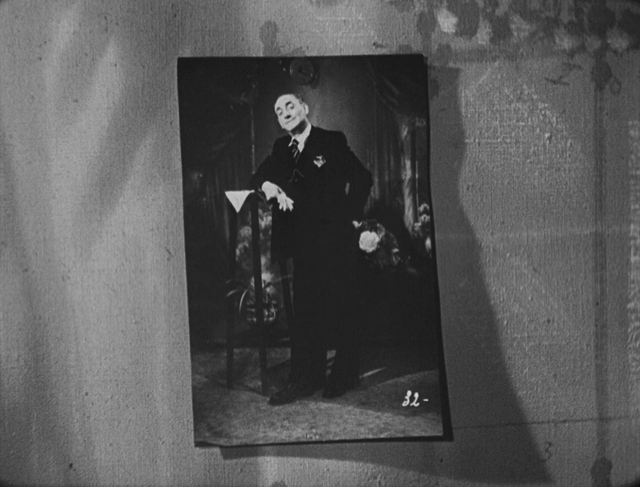
Rossellini is concerned with the symbolic importance of the camera and, by extension, the nature of photography itself. Celestino seems to represent a comical caricature of neorealist mythology about the magic powers of the movie camera. He believes the camera can serve as a means of separating reality from illusion, good from evil, substance from appearance. Photography for Celestino (and for many of the more doctrinaire neorealist theorists) is a metaphor for a way of knowing, for a means of apprehending essential moral and ethical facts. It enables Celestino, so he believes, to penetrate the surface of events to the bedrock of reality and to fulfill a godlike role in his small village, not unlike that a film director plays on a set, where he or she, too, is all powerful. It is thus very significant that Celestino does not perform his miraculous photographic feats by directly duplicating objects from the "real" world on his film stock. Instead, the power given to him by the old man only operates when he films an object self-reflexively by taking a photograph of another photograph, not the object itself. As any good Platonist knows, Celestino thus remains not one step but two steps removed from the world of tangible phenomena and is engaged in the essentially self-reflexive act of producing a work of art from another work of art, not directly producing art from reality.
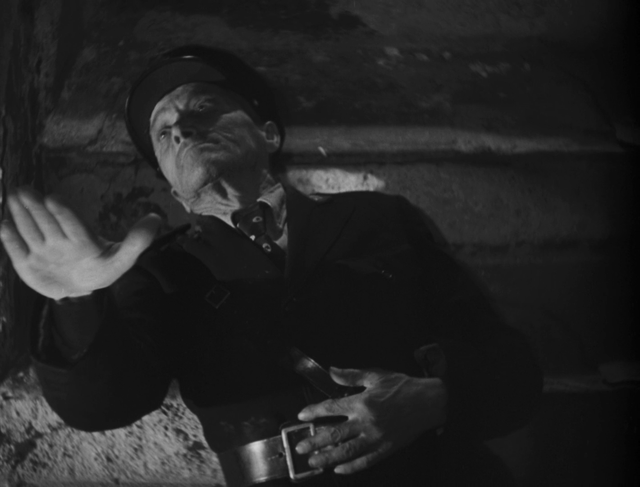
While presenting us with an elaborate comic portrait of Celestino's self-delusory activity, Rossellini is also emphasizing a fundamental trait of the cinema. Photography and, by extension, the cinema as a branch of this art form of mechanical reproduction are incapable of separating good from evil or readily distinguishing reality from appearance. When objects are photographed, the act of photography does not in itself have any interpretative or cognitive value whatsoever. It is the perspective of the photographer that gives the act of photographic reproduction meaning, not the technical operation involved. As Rossellini and other neorealist directors often argued, neorealism was first a moral position before it was an aesthetic or technical point of view. To photograph or film from a particular perspective, the photographer or director must start from a moral or ethical position that lends itself to creating a work of art. In Rossellini's La macchina ammazzacattivi, Celestino has no truly superior moral position on which to stand, no fixed point that grants him authentic moral superiority over his fellow townspeople. Ultimately, he discovers that he and they are all motivated by self-interest and he is no better than they are, except that his own egotism takes the form of a seemingly benevolent desire to punish the wicked. And Celestino gets everything wrong. He takes what is revealed to be a demon to be the town's patron saint, apparently kills his friend the town doctor in a moment of madness, and generally makes a complex muddle of all his good intentions.
Celestino's comic misadventures are presented within the framework of a caricature, a grossly exaggerated collection of individuals who would rarely be encountered in society. But the commedia delParte conventions require characters defined as stock types - in this case, all dominated by a single selfish emotion. Rossellini ends the film with a rhymed epilogue suggesting a moral that, along with the opening prologue, provides a frame
for the actions of his characters. The very fact that the storyline develops within such a frame is yet another device for foregrounding the metacinematic aspects of the film, just as literary classics with even more complex
framing devices (such as The Decameron and The Arabian Nights) are ultimately about storytelling itself. And the moral of the epilogue is a message that orthodox neorealists would certainly find objectionable:
We'll take down the sets, my friends.
The play is over. Here's the moral:
Do good but don't overdo it!
Avoid evil, for your own sake.
Don't be too hasty in judging others.
Think twice before you punish anyone.
I'll leave now for time does fly,
So I'll take my bow and say goodbye.
Not only has Rossellini defined the camera as a morally neutral instrument, completely dependent upon an act of interpretation that precedes the moment of artistic creation (in this case, photography), but he has shown the
camera to be not a means of acquiring knowledge of social reality but, instead, a fallible instrument that reflects not reality but human subjectivity and error. La macchina ammazzacattivi questions the cognitive potential of the camera and undermines the belief that good and evil are easily distinguished. Moreover, the sense of moral indignation over the exploitation of the poor by the rich, so central an element in all of the greatest neorealist
films, seems now to have been abandoned.
It would be a mistake to equate the artistic merits of La macchina ammazzacattivi to those of Rossellini's greatest works. But it would also be critically incorrect to ignore the film, as so many critics of Rossellini have done in the past. A flawed, imperfect work, it nevertheless serves as testimony to the transition taking place in Rossellini's career from neorealism to an entirely different kind of cinema that would find its most felicitous expression in his work with Ingrid Bergman. (Peter Bondanella)

[ About file ]
Name: The Machine That Kills Bad People.Roberto Rossellini.1952.BluRay KESH..mkv
Date: Mon, 06 Jul 2026 04:37:26 +0200
Size: 7,547,845,826 bytes (7198.186708 MiB)
[ Magic ]
File type: Matroska data
File type: EBML file, creator matroska
[ Generic infos ]
Duration: 01:24:35 (5074.73 s)
Container: matroska
Production date: Mon, 07 Sep 2015 08:25:03 +0200
Total tracks: 5
Track nr. 1: video (V_MPEG4/ISO/AVC) [La Macchina Ammazzacattivi AKA The Machine That Kills Bad People 1952 1080p BluRay AAC2.0 x264-KESH] {ita}
Track nr. 2: audio (A_AAC) [320 kbps] {ita}
Track nr. 3: subtitle (S_TEXT/UTF8) [SRT] {eng}
Track nr. 4: subtitle (S_VOBSUB) [VOB] {eng}
Track nr. 5: subtitle (S_HDMV/PGS) [SUP] {eng}
Muxing library: libebml v1.3.1 + libmatroska v1.4.2
Writing application: mkvmerge v8.3.0 ('Over the Horizon') 64bit
[ Relevant data ]
Resolution: 1420 x 1080
Width: multiple of 4
Height: multiple of 8
Average DRF: 19.597563
Standard deviation: 2.935088
Std. dev. weighted mean: 2.901244
[ Video track ]
Codec ID: V_MPEG4/ISO/AVC
Resolution: 1420 x 1080
Frame aspect ratio: 71:54 = 1.314815
Pixel aspect ratio: 1:1 = 1
Display aspect ratio: 71:54 = 1.314815
Framerate: 24 fps
Stream size: 7,332,936,324 bytes (6993.233036 MiB)
Duration (bs): 01:24:35 (5074.708252 s)
Bitrate (bs): 11559.973042 kbps
Qf: 0.314075
[ Audio track ]
Codec ID: A_AAC
Sampling frequency: 48000 Hz
Channels: 2
Stream size: 198,795,673 bytes (189.586328 MiB)
Bitstream type (bs): AAC LC (Low Complexity)
Frames (bs): 237,877
Duration (bs): 01:24:35 (5074.709333 s)
Chunk-aligned (bs): Yes
Bitrate (bs): 313.390439 kbps VBR
Sampling frequency (bs): 48000 Hz
Mode (bs): 2: front-left, front-right
[ Video bitstream ]
Bitstream type: MPEG-4 Part 10
User data: x264 | core 142 r2479 dd79a61 | H.264/MPEG-4 AVC codec
User data: Copyleft 2003-2014 | http://www.videolan.org/x264.html | cabac=1
User data: ref=5 | deblock=1:-3:-3 | analyse=0x3:0x133 | me=tesa | subme=11
User data: psy=1 | psy_rd=1.00:0.10 | mixed_ref=1 | me_range=44 | chroma_me=1
User data: trellis=2 | 8x8dct=1 | cqm=0 | deadzone=21,11 | fast_pskip=0
User data: chroma_qp_offset=-3 | threads=12 | lookahead_threads=3
User data: sliced_threads=0 | nr=0 | decimate=1 | interlaced=0
User data: bluray_compat=0 | constrained_intra=0 | bframes=16 | b_pyramid=1
User data: b_adapt=2 | b_bias=0 | direct=3 | weightb=1 | open_gop=0 | weightp=2
User data: keyint=240 | keyint_min=24 | scenecut=40 | intra_refresh=0
User data: rc_lookahead=60 | rc=crf | mbtree=1 | crf=18.0 | qcomp=0.60
User data: qpmin=0 | qpmax=69 | qpstep=4 | vbv_maxrate=62500
User data: vbv_bufsize=78125 | crf_max=0.0 | nal_hrd=none | filler=0
User data: ip_ratio=1.40 | aq=1:0.80
SPS id: 0
Profile: High@L4.1
Num ref frames: 4
Chroma format: YUV 4:2:0
PPS id: 0 (SPS: 0)
Entropy coding type: CABAC
Weighted prediction: P slices - explicit weighted prediction
Weighted bipred idc: B slices - implicit weighted prediction
8x8dct: Yes
Total frames: 121,793
Drop/delay frames: 0
Corrupt frames: 0
P-slices: 23542 ( 19.330 %) ####
B-slices: 97629 ( 80.160 %) ################
I-slices: 622 ( 0.511 %)
SP-slices: 0 ( 0.000 %)
SI-slices: 0 ( 0.000 %)
[ DRF analysis ]
average DRF: 19.597563
standard deviation: 2.935088
max DRF: 28
DRF=1: 9 ( 0.007 %)
DRF=2: 2 ( 0.002 %)
DRF=3: 0 ( 0.000 %)
DRF=4: 145 ( 0.119 %)
DRF=5: 28 ( 0.023 %)
DRF=6: 20 ( 0.016 %)
DRF=7: 25 ( 0.021 %)
DRF=8: 21 ( 0.017 %)
DRF=9: 44 ( 0.036 %)
DRF=10: 74 ( 0.061 %)
DRF=11: 3066 ( 2.517 %) #
DRF=12: 119 ( 0.098 %)
DRF=13: 300 ( 0.246 %)
DRF=14: 703 ( 0.577 %)
DRF=15: 2023 ( 1.661 %)
DRF=16: 5585 ( 4.586 %) #
DRF=17: 12078 ( 9.917 %) ##
DRF=18: 16532 ( 13.574 %) ###
DRF=19: 15908 ( 13.062 %) ###
DRF=20: 19833 ( 16.284 %) ###
DRF=21: 18345 ( 15.062 %) ###
DRF=22: 10000 ( 8.211 %) ##
DRF=23: 6249 ( 5.131 %) #
DRF=24: 4974 ( 4.084 %) #
DRF=25: 3250 ( 2.668 %) #
DRF=26: 1956 ( 1.606 %)
DRF=27: 467 ( 0.383 %)
DRF=28: 37 ( 0.030 %)
DRF>28: 0 ( 0.000 %)
P-slices average DRF: 18.950556
P-slices std. deviation: 2.639454
P-slices max DRF: 28
B-slices average DRF: 19.777843
B-slices std. deviation: 2.963231
B-slices max DRF: 28
I-slices average DRF: 15.789389
I-slices std. deviation: 3.080227
I-slices max DRF: 23
[ Edition entry ]
UID: 17616917474166232503
Hidden: No
Selected by default: Yes
Playlist: No
Chapters:
00:00:00,000-00:13:30,250: Chapter 1 {und}
00:13:30,333-00:23:36,417: Chapter 2 {und}
00:23:36,500-00:42:25,208: Chapter 3 {und}
00:42:25,291-00:54:41,333: Chapter 4 {und}
00:54:41,416-01:03:56,042: Chapter 5 {und}
01:03:56,125-01:15:52,708: Chapter 6 {und}
01:15:52,791-01:24:34,667: Chapter 7 {und}
This report was created by AVInaptic (01-11-2020) on 8-08-2026 00:47:19