The Essential Max Müller - On Language, Mythology, and Religion
About The Essential Max Müller - On Language, Mythology, and Religion
Overview
The Essential Max Müller: On Language, Mythology, and Religion https://WebToolTip.com English | 2003 | ISBN-10: 0312293097 | 367 pages| PDF (True) | 44 MB Max Müller is often referred to as the 'father of Religious Studies', having himself coined the term 'science of religion' (or religionswissenschaft) in 1873. It was he who encouraged the comparative study of myth and ritual, and it was he who introduced the oft-quoted dictum: 'He who knows one[religion], knows none'. Though a German-born and
Frequently Asked Questions
How do I download The Essential Max Müller - On Language, Mythology, and Religion?
Click the magnet or torrent download button on this page to start downloading The Essential Max Müller - On Language, Mythology, and Religion. A BitTorrent client is required.
What is the file size of The Essential Max Müller - On Language, Mythology, and Religion?
The total size of The Essential Max Müller - On Language, Mythology, and Religion is 45.0 MB.
How many seeders are available for The Essential Max Müller - On Language, Mythology, and Religion?
The Essential Max Müller - On Language, Mythology, and Religion currently has 22285 seeders, which affects download speed.
What category is The Essential Max Müller - On Language, Mythology, and Religion in?
The Essential Max Müller - On Language, Mythology, and Religion is listed under Other on 1337x.
The Essential Max Müller: On Language, Mythology, and Religion
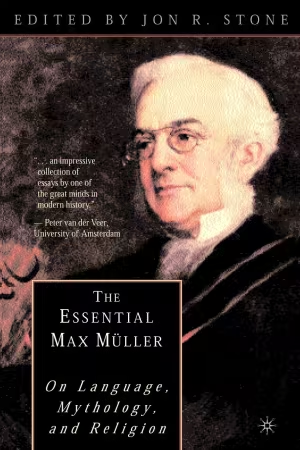
https://WebToolTip.com
English | 2003 | ISBN-10: 0312293097 | 367 pages| PDF (True) | 44 MB
Max Müller is often referred to as the 'father of Religious Studies', having himself coined the term 'science of religion' (or religionswissenschaft) in 1873. It was he who encouraged the comparative study of myth and ritual, and it was he who introduced the oft-quoted dictum: 'He who knows one[religion], knows none'. Though a German-born and German-educated philologist, he spent the greater part of his career at Oxford, becoming one of the most famous of the Victorian arm-chair scholars. Müller wrote extensively on Indian philosophy and Vedic religion, translated major sections of the Vedas, the Upanisads, and all of the Dhammapada, yet never visited India. To be sure, his work bears the stamp of late Nineteenth-Century sensibilities, but as artifacts of Victorian era scholarship, Müller's essays are helpful in reconstructing and comprehending the intellectual concerns of this highly enlightened though highly imperialistic age.