Mastering Large Language Models - Architectures, Applications, an...
About Mastering Large Language Models - Architectures, Applications, an...
Overview
Mastering Large Language Models: Architectures, Applications, and Real-World Deployments of Large Language Models https://WebToolTip.com English | 2026 | ISBN: 9798868827327 | 589 pages | PDF | 41.75 MB This book is a hands-on guide designed to help readers understand, build, and deploy powerful AI solutions using Large Language Models (LLMs), Retrieval-Augmented Generation (RAG), agentic systems, and intelligent chatbots. Starting with the fundamentals—LLM architecture, tokenization, APIs, and
Frequently Asked Questions
How do I download Mastering Large Language Models - Architectures, Applications, an...?
Click the magnet or torrent download button on this page to start downloading Mastering Large Language Models - Architectures, Applications, an.... A BitTorrent client is required.
What is the file size of Mastering Large Language Models - Architectures, Applications, an...?
The total size of Mastering Large Language Models - Architectures, Applications, an... is 41.8 MB.
How many seeders are available for Mastering Large Language Models - Architectures, Applications, an...?
Mastering Large Language Models - Architectures, Applications, an... currently has 26449 seeders, which affects download speed.
What category is Mastering Large Language Models - Architectures, Applications, an... in?
Mastering Large Language Models - Architectures, Applications, an... is listed under Other on 1337x.
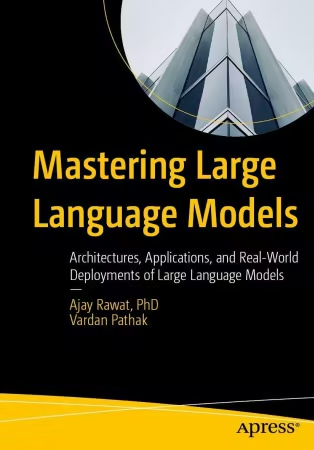
Mastering Large Language Models: Architectures, Applications, and Real-World Deployments of Large Language Models
https://WebToolTip.com
English | 2026 | ISBN: 9798868827327 | 589 pages | PDF | 41.75 MB
This book is a hands-on guide designed to help readers understand, build, and deploy powerful AI solutions using Large Language Models (LLMs), Retrieval-Augmented Generation (RAG), agentic systems, and intelligent chatbots.
Starting with the fundamentals—LLM architecture, tokenization, APIs, and fine-tuning—the book gradually builds toward complex, integrated systems. Readers will learn to implement RAG pipelines using vector databases like FAISS and Pinecone, develop autonomous AI agents that complete multi-step tasks, and create real-world chatbots that understand and adapt to user needs. The approach is project-driven: each chapter includes visual explanations, step-by-step code walkthroughs, and deployment-ready examples. From building a personal assistant that searches your notes to creating a scheduling agent, every project reinforces both technical skills and applied understanding. It emphasizes clarity, inclusivity, and real-world relevance—helping readers move confidently from basic understanding to complex applications.