Buddhism and Deliberative Democracy
About Buddhism and Deliberative Democracy
Overview
Buddhism and Deliberative Democracy https://WebToolTip.com English | 2026 | ISBN-10: 3032206901 | 129 pages| Epub PDF (True) | 5 MB In this open-access book, William J. Long argues that the Buddhist saṅgha—whose governance the Buddha modeled in part on the republican assemblies of his era—was not only a religious community, but a sophisticated experiment in deliberative cracy. Designed as a self-governing polity, the saṅgha served as an exemplar for society in the Buddha’s time and offers a stri
Frequently Asked Questions
How do I download Buddhism and Deliberative Democracy?
Click the magnet or torrent download button on this page to start downloading Buddhism and Deliberative Democracy. A BitTorrent client is required.
What is the file size of Buddhism and Deliberative Democracy?
The total size of Buddhism and Deliberative Democracy is 5.0 MB.
How many seeders are available for Buddhism and Deliberative Democracy?
Buddhism and Deliberative Democracy currently has 23131 seeders, which affects download speed.
What category is Buddhism and Deliberative Democracy in?
Buddhism and Deliberative Democracy is listed under Other on 1337x.
Buddhism and Deliberative Democracy
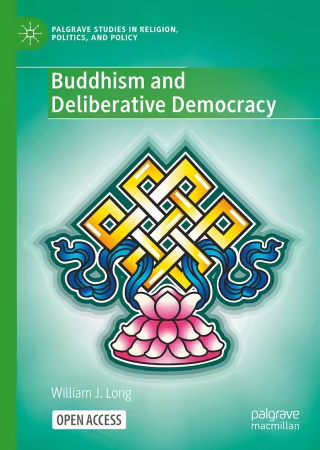
https://WebToolTip.com
English | 2026 | ISBN-10: 3032206901 | 129 pages| Epub PDF (True) | 5 MB
In this open-access book, William J. Long argues that the Buddhist saṅgha—whose governance the Buddha modeled in part on the republican assemblies of his era—was not only a religious community, but a sophisticated experiment in deliberative cracy. Designed as a self-governing polity, the saṅgha served as an exemplar for society in the Buddha’s time and offers a strikingly relevant model for our own.
At a moment when cracies around the world face declining effectiveness, political theorists increasingly turn to deliberative cracy as a remedy. This approach holds that cratic decisions become more legitimate, more informed, and more stable through the public exchange of reasons among free and equal citizens. Ideally, deliberation aims at reasoned consensus oriented toward the common good, rather than outcomes driven solely by power or competing self-interests. Yet nearly all contemporary accounts of deliberative cracy are Western in origin and largely confined to late twentieth- and twenty-first-century thought.