Medicinal Plants with Anti-Ageing Properties
About Medicinal Plants with Anti-Ageing Properties
Overview
Medicinal Plants with Anti-Ageing Properties https://WebToolTip.com English | 2026 | ISBN-10: 9819580633 | 490 pages | Epub PDF (True) | 55 MB To ensure sustainable production of pharmaceutically significant active metabolites (from natural sources) with anti-aging properties, biotechnological interventions become the need of the hour when global warming and environmental pollution result in increasing UV radiation and, consequently, sunburn and aging of the tissue. In that context, the introduc
Frequently Asked Questions
How do I download Medicinal Plants with Anti-Ageing Properties?
Click the magnet or torrent download button on this page to start downloading Medicinal Plants with Anti-Ageing Properties. A BitTorrent client is required.
What is the file size of Medicinal Plants with Anti-Ageing Properties?
The total size of Medicinal Plants with Anti-Ageing Properties is 55.1 MB.
How many seeders are available for Medicinal Plants with Anti-Ageing Properties?
Medicinal Plants with Anti-Ageing Properties currently has 12184 seeders, which affects download speed.
What category is Medicinal Plants with Anti-Ageing Properties in?
Medicinal Plants with Anti-Ageing Properties is listed under Other on 1337x.
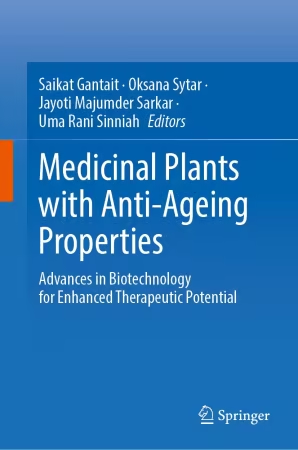
Medicinal Plants with Anti-Ageing Properties
https://WebToolTip.com
English | 2026 | ISBN-10: 9819580633 | 490 pages | Epub PDF (True) | 55 MB
To ensure sustainable production of pharmaceutically significant active metabolites (from natural sources) with anti-aging properties, biotechnological interventions become the need of the hour when global warming and environmental pollution result in increasing UV radiation and, consequently, sunburn and aging of the tissue. In that context, the introductory chapter of this book outlines the concept and importance of medicinal plants available in local, national, and global regions that are rich in bioactive compounds responsible for anti-aging effects, along with their distribution, status, and limitations of conventional propagation and their biotechnological enhancement. The subsequent chapter provides insights into how environmental changes affect the anti-aging properties of metabolites in medicinal plants. There are dedicated chapters that provide insights on the genetic basis of anti-aging activity, the chemistry and physiology of modes of action, as well as the cellular mechanisms of secondary metabolites, along with the role of phytohormones for in vitro mass propagation, somatic embryos, their maturation, and the regeneration of anti-aging medicinal plants. Enhancement of anti-aging properties and the production of secondary metabolites with the interventions of LEDs, cell suspension, elicitation, bioreactor, auto-polyploidization, induced mutagenesis, and nanotechnology, as well as CRISPR/Cas9-mediated genome editing. Apart from genetic improvements, focus is given on conservation and exchange of anti-aging medicinal plants via cryopreservation and synthetic seed technologies. In conclusion, the study comprehensively covers secondary metabolite extraction techniques and the clinical evidence and significance of these metabolites. Expert scientists from 15 different countries, such as Argentina, Belgium, Botswana, Cameroon, China, Cuba, Czech Republic, Egypt, France, India, Japan, Mexico, South Africa, Türkiye, and Vietnam, have contributed 14 insightful chapters to this book. It is noteworthy to mention that there is a sustainable hunt for possible novel anti-aging compounds from natural resources, especially plants and herbs, and this book will be a potential guideline to facilitate that endeavor.