Elements of Electricity and Electro-Chemistry
About Elements of Electricity and Electro-Chemistry
Overview
Elements of Electricity and Electro-Chemistry https://WebToolTip.com English | ISBN: 1108079229 | 2015 | 520 pages | PDF | 16 MB The amateur scientist George John Singer (1786–1817) worked in the family business of artificial flower and feather making, but all his spare time was absorbed in the study of electricity and electromagnetism. He invented his own apparatus, including a gold-leaf electrometer, and built a laboratory-cum-lecture room at the back of his house: his public nstrations were a
Frequently Asked Questions
How do I download Elements of Electricity and Electro-Chemistry?
Click the magnet or torrent download button on this page to start downloading Elements of Electricity and Electro-Chemistry. A BitTorrent client is required.
What is the file size of Elements of Electricity and Electro-Chemistry?
The total size of Elements of Electricity and Electro-Chemistry is 16.4 MB.
How many seeders are available for Elements of Electricity and Electro-Chemistry?
Elements of Electricity and Electro-Chemistry currently has 25986 seeders, which affects download speed.
What category is Elements of Electricity and Electro-Chemistry in?
Elements of Electricity and Electro-Chemistry is listed under Other on 1337x.
Elements of Electricity and Electro-Chemistry
https://WebToolTip.com
English | ISBN: 1108079229 | 2015 | 520 pages | PDF | 16 MB
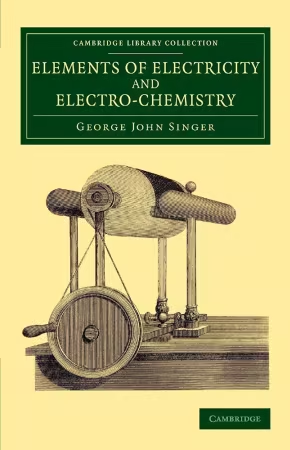
The amateur scientist George John Singer (1786–1817) worked in the family business of artificial flower and feather making, but all his spare time was absorbed in the study of electricity and electromagnetism. He invented his own apparatus, including a gold-leaf electrometer, and built a laboratory-cum-lecture room at the back of his house: his public nstrations were attended by Faraday and Francis Ronalds, and he was also a friend of the pioneering 'electrician' Andrew Crosse. This significant book, published in 1814, nstrates the breadth of Singer's knowledge of his subject and of other contemporary work in the field. It describes in detail electric phenomena, in nature and in the laboratory, covering a wide range of experiments with and applications of electricity, and discussing the work of Franklin, Volta, Crosse and Dalton, among others. Sadly, Singer's promising scientific career was brought to an early end by tuberculosis: he died aged only thirty-one.