US-China Rivalry - Great Power Competition in the Indo-Pacific
About US-China Rivalry - Great Power Competition in the Indo-Pacific
Overview
US-China Rivalry: Great Power Competition in the Indo-Pacific https://WebToolTip.com English | 2024 | ISBN: 1399534165 | 340 Pages | PDF | 15 MB US-China Rivalry offers a holistic analysis of the unfolding of US-China competition in the Indo-Pacific, using a novel theory called neo-offensive realism. It synthesises quantitative and qualitative data to examine the intensification of US-China competition across the Indo-Pacific in recent years, with a focus on why the competition is intensifying u
Frequently Asked Questions
How do I download US-China Rivalry - Great Power Competition in the Indo-Pacific?
Click the magnet or torrent download button on this page to start downloading US-China Rivalry - Great Power Competition in the Indo-Pacific. A BitTorrent client is required.
What is the file size of US-China Rivalry - Great Power Competition in the Indo-Pacific?
The total size of US-China Rivalry - Great Power Competition in the Indo-Pacific is 15.4 MB.
How many seeders are available for US-China Rivalry - Great Power Competition in the Indo-Pacific?
US-China Rivalry - Great Power Competition in the Indo-Pacific currently has 14897 seeders, which affects download speed.
What category is US-China Rivalry - Great Power Competition in the Indo-Pacific in?
US-China Rivalry - Great Power Competition in the Indo-Pacific is listed under Other on 1337x.
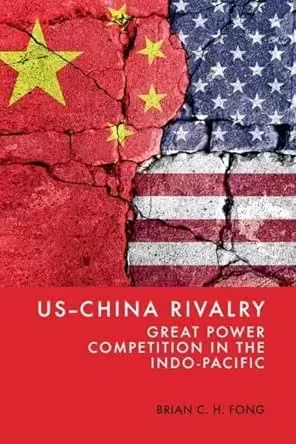
US-China Rivalry: Great Power Competition in the Indo-Pacific
https://WebToolTip.com
English | 2024 | ISBN: 1399534165 | 340 Pages | PDF | 15 MB
US-China Rivalry offers a holistic analysis of the unfolding of US-China competition in the Indo-Pacific, using a novel theory called neo-offensive realism. It synthesises quantitative and qualitative data to examine the intensification of US-China competition across the Indo-Pacific in recent years, with a focus on why the competition is intensifying under the interplay of system-level and unit-level forces; where the competition is unfolding across states and quasi-states in the region; how the competition is conducted through economic and military influence mechanisms; and whither the competition is developing in the future.