Scientific Machine Learning with Engineering Applications
About Scientific Machine Learning with Engineering Applications
Overview
Scientific Machine Learning with Engineering Applications https://WebToolTip.com English | 2026 | ISBN-10: 3032203066 | 243 pages| Epub PDF (True) | 63 MB This book equips readers with a rigorous and practical framework for solving complex engineering problems directly from governing equations using modern machine learning techniques. It bridges established principles from mechanics, numerical analysis, and scientific computing with emerging physics-based learning approaches, enabling reliable m
Frequently Asked Questions
How do I download Scientific Machine Learning with Engineering Applications?
Click the magnet or torrent download button on this page to start downloading Scientific Machine Learning with Engineering Applications. A BitTorrent client is required.
What is the file size of Scientific Machine Learning with Engineering Applications?
The total size of Scientific Machine Learning with Engineering Applications is 64.9 MB.
How many seeders are available for Scientific Machine Learning with Engineering Applications?
Scientific Machine Learning with Engineering Applications currently has 12332 seeders, which affects download speed.
What category is Scientific Machine Learning with Engineering Applications in?
Scientific Machine Learning with Engineering Applications is listed under Other on 1337x.
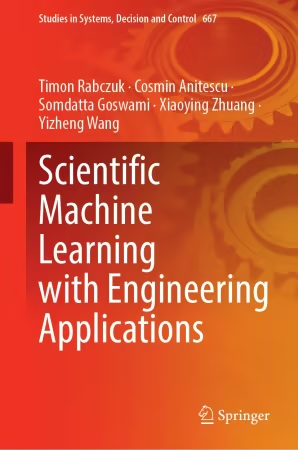
Scientific Machine Learning with Engineering Applications
https://WebToolTip.com
English | 2026 | ISBN-10: 3032203066 | 243 pages| Epub PDF (True) | 63 MB
This book equips readers with a rigorous and practical framework for solving complex engineering problems directly from governing equations using modern machine learning techniques. It bridges established principles from mechanics, numerical analysis, and scientific computing with emerging physics-based learning approaches, enabling reliable modeling, simulation, optimization, and inverse analysis beyond purely data-driven methods. A distinctive feature is its critical comparison of machine learning-based solvers with classical techniques such as the finite element method, isogeometric analysis, and meshfree methods, highlighting strengths, limitations, and domains of applicability. The scope ranges from foundational concepts to advanced engineering applications, supported by worked examples, reproducible code, and extensive references. The book is intended for graduate students, researchers, and practitioners in engineering, applied mathematics, and computational sciences who seek a principled entry point and a state-of-the-art reference for physics-based machine learning in modeling and simulation.