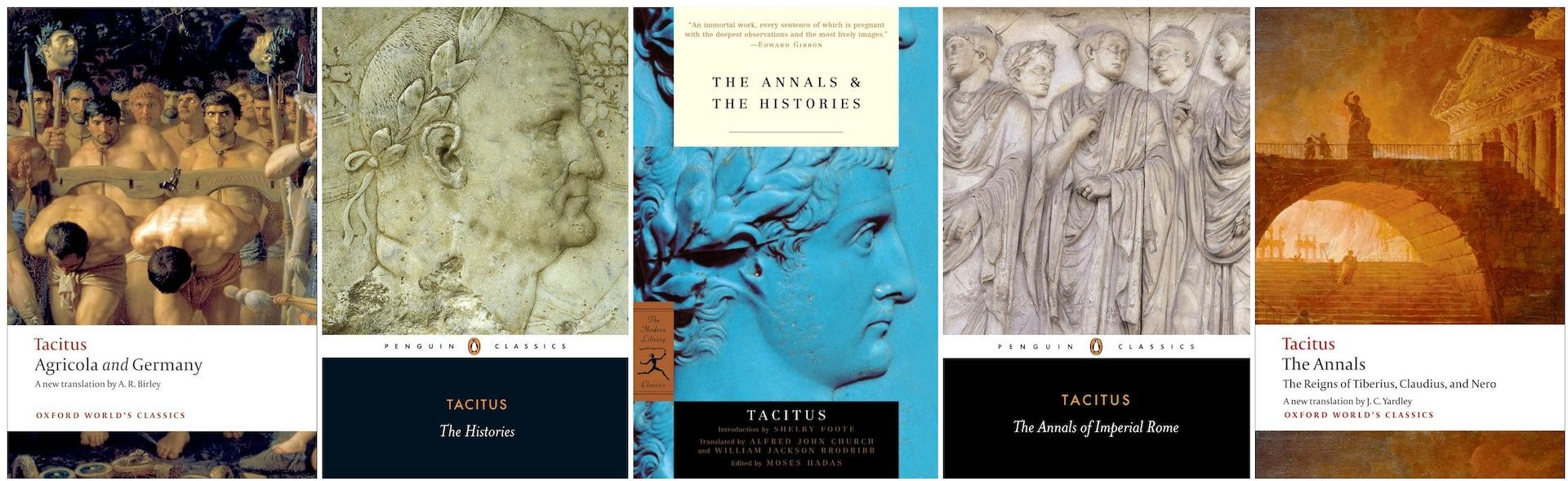
Tacitus - Collected Works on Ancient Rome (12 books)
About Tacitus - Collected Works on Ancient Rome (12 books)
Overview
* Tacitus - Collected Works on Ancient Rome (12 books) PUBLIUS CORNELIUS TACITUS (c. 56 – c. 120 CE) was a preeminent Roman historian and politician whose works provide a critical, often scathing, analysis of the early Roman Empire. He is widely regarded as one of the greatest Roman historians by modern scholars. A member of the equestrian class who rose through the political ranks to become a consul, his political career provided him with an insider's view of the Roman state’s inner workings, t
Frequently Asked Questions
How do I download Tacitus - Collected Works on Ancient Rome (12 books)?
Click the magnet or torrent download button on this page to start downloading Tacitus - Collected Works on Ancient Rome (12 books). A BitTorrent client is required.
What is the file size of Tacitus - Collected Works on Ancient Rome (12 books)?
The total size of Tacitus - Collected Works on Ancient Rome (12 books) is 68.1 MB.
How many seeders are available for Tacitus - Collected Works on Ancient Rome (12 books)?
Tacitus - Collected Works on Ancient Rome (12 books) currently has 29304 seeders, which affects download speed.
What category is Tacitus - Collected Works on Ancient Rome (12 books) in?
Tacitus - Collected Works on Ancient Rome (12 books) is listed under Other on 1337x.

* Tacitus - Collected Works on Ancient Rome (12 books)
PUBLIUS CORNELIUS TACITUS (c. 56 – c. 120 CE) was a preeminent Roman historian and politician whose works provide a critical, often scathing, analysis of the early Roman Empire. He is widely regarded as one of the greatest Roman historians by modern scholars. A member of the equestrian class who rose through the political ranks to become a consul, his political career provided him with an insider's view of the Roman state’s inner workings, though his worldview was profoundly darkened by surviving the "reign of terror" under Emperor Domitian. This experience instilled in him a deep skepticism toward absolute power and a preoccupation with the decline of Republican liberty.
Tacitus's early minor works, the AGRICOLA and the GERMANIA , both published around 98 CE, laid the foundation for his reputation. The AGRICOLA is a biographical eulogy for his father-in-law, Gnaeus Julius Agricola, who served as a distinguished governor of Britain. While honoring Agricola's virtues, the work also serves as a critique of imperial tyranny and provides one of the first detailed accounts of Roman Britain. The GERMANIA , an ethnographic study of the Germanic tribes, contrasts the perceived moral simplicity and vigor of the "barbarians" with the decadence of contemporary Rome, serving as both a record and a cautionary moral tale. The DIALOGUE ON ORATORS (c. 102 CE) explores the decline of oratory during the imperial period, reflecting on the loss of political freedom.
His two major historical works, the HISTORIES and the ANNALS , originally formed a continuous narrative of the Roman Empire from the death of Augustus (14 CE) to the end of Domitian's reign (96 CE). Despite substantial lacunae—missing sections—these works are celebrated for their dense, ironic prose and penetrating psychological insights into the motivations of emperors and their subjects, offering a vivid, systematic account of civil war and political instability.
The HISTORIES , written first, chronicled the tumultuous "Year of the Four Emperors" (69 CE) and the subsequent Flavian dynasty up to the death of Domitian in 96 CE. The ANNALS , Tacitus's final and most mature work, is often considered the pinnacle of Roman historical writing. Covering the period from the death of Augustus (14 CE) to the death of Nero (68 CE), it explores the reigns of the Julio-Claudian emperors with penetrating psychological insight. Famously stating he wrote sine ira et studio ("without anger or bias"), Tacitus nevertheless used the work to diagnose the moral decay of the Roman elite and the corrupting nature of dynastic power.
Through his incisive analysis of "power without accountability," Tacitus remains a cornerstone of ancient historiography. His commitment to documenting the dangerous nature of autocracy continues to resonate, as he expertly navigated the tension between the necessity of imperial rule and the erosion of traditional Roman liberty.
The following books are ePUB and/or PDF as noted:
* Agricola & Germania [tr. Mattingly & Rives] (Penguin, 2009) – ePUB
* Agricola & Germany [tr. Birley] (Oxford, 1999) – ePUB / PDF
* Agricola, Germany, and Dialogue on Orators [tr. Benario] (Hackett, 2006) – PDF
* Annals [tr. Damon] (Penguin, 2012) – ePUB
* Annals [tr. Woodman] (Hackett, 2004) – PDF
* Annals [tr. Yardley] (Oxford, 2008) – ePUB / PDF
* Annals & Histories [tr. Church & Brodribb] (Modern Library, 2003) – ePUB
* Annals of Imperial Rome [tr. Grant, revised] (Penguin, 1996) – ePUB
* Complete Works (Delphi Classics, 2014) – ePUB
* The Histories [tr. Fyfe & Levene, revised] (Oxford, 1997) – PDF
* The Histories [tr. Wellesley & Ash, revised] (Penguin, 2009) – ePUB
* Histories I: A Selection [ed. O'Gorman & Gravell] (Bloomsbury, 2018) – ePUB / PDF
Please seed and share with others. 🙂